Bluehost has been on WordPress.org’s recommended hosts list for over 20 years. The platform is either that good, or just been around long enough for the endorsement to become furniture.
I signed up for both managed WordPress hosting and a Self-Managed VPS to know the truth. Over 30 days, I ran GTmetrix on a live WordPress site, a full Linux benchmark suite on the VPS, two rounds of stress testing, and a real technical question through live chat.
I also dug into the refund policy, the dashboard, and pricing. Not everything is as impressive as it seems, but it can still be valuable for certain users. Here’s a full breakdown of my hands-on experience.
To evaluate Bluehost, I applied our hosting review methodology, a structured approach I use consistently across all my reviews to keep scores grounded in real testing rather than marketing claims.
The scores below reflect what I found across both the managed WordPress hosting and the Self-Managed VPS.
| Parameter | Score | Why This Score |
|---|---|---|
| Prices | 9.1/10 | Plan tiers are well positioned for the hardware and features included. The promotional rate sits well below renewal pricing, so the cost gap between the first term and ongoing terms is worth checking before you lock in. |
| Features | 9.2/10 | WordPress.org recommendation since 2005, AI website builder, managed WP updates, NVMe storage with global CDN, AMD EPYC and DDR5 on VPS, full root access, and six WordPress data center locations cover both casual and developer use cases. |
| Ease of Use | 9.3/10 | The signup flow is transparent through configuration and checkout on both products. The Account Manager dashboard is modern, and the one-click WordPress Admin button from the Websites section is a real day-to-day time saver. |
| Performance | 9.2/10 | The WordPress test site delivered excellent results, earning a 91% GTmetrix performance score and loading key content in just over a second. The VPS handled demanding workloads with ease and remained stable throughout all our stress tests, with no issues or failures detected. |
| Support | 9.2/10 | The chat channel routes through an AI assistant first and requires an explicit request to reach a human. Once through, Sharath gave product-accurate answers for both the WordPress and VPS contexts I tested. |
| Overall | 9.2/10 | Bluehost holds up as a well-rounded platform across both managed WordPress and self-managed VPS. The pricing structure and AI-first support are the two items I would read carefully before signing up. |
Bluehost offers WordPress hosting (Starter, Business, eCommerce Essentials), Self-Managed VPS (NVMe 2, 4, 8, 16), plus Shared, Dedicated, Cloud, and developer products.
A 30-day money-back guarantee covers new Shared, VPS, and Dedicated signups (excluding Cloud, monthly billing, domains, AI Products, and most add-ons).
Card refunds are processed in 5 to 7 business days. Payments are available via card, Google Pay, and PayPal. Watch out for promotional prices that apply only to the first term, with higher renewal rates.
| Plan Name | Space | Bandwidth | OS | Panel | Number of Sites | Price | |
|---|---|---|---|---|---|---|---|
| Starter | 10 GB | Unlimited | cPanel | 10 | $3.99 | Details | |
| Business Essentials | 50 GB | Unlimited | cPanel | 50 | $6.99 | Details | |
| High Performance Pro | 100 GB | Unlimited | cPanel | 100 | $9.99 | Details | |
| High Performance Premium | 150 GB | Unlimited | cPanel | 100 | $13.99 | Details | |
| eCommerce Essentials | 100 GB | Unlimited | cPanel | 100 | $14.99 | Details | |
| High Performance Enhanced | 200 GB | Unlimited | cPanel | 100 | $16.99 | Details | |
| High Performance Elite | 250 GB | Unlimited | cPanel | 100 | $19.99 | Details |
| Plan Name | Space | CPU | RAM | OS | Price | |
|---|---|---|---|---|---|---|
| Standard NVMe 32 | 1 TB | 8 cores | 32 GB | $144.19 | Details | |
| Enhanced NVMe 64 | 2 TB | 32 cores | 64 GB | $220.23 | Details | |
| Premium NVMe 128 | 3 TB | 32 cores | 128 GB | $315.19 | Details |
| Plan Name | CPU | RAM | Bandwidth | Warranty | Price | |
|---|---|---|---|---|---|---|
| Starter | - | Unlimited | $0.00 | $3.99 | Details | |
| Business | - | Unlimited | $0.00 | $6.99 | Details | |
| eCommerce Essentials | - | Unlimited | $0.00 | $14.99 | Details |
| Feature | Description |
|---|---|
| AMD EPYC and DDR5 on VPS | Every Self-Managed VPS plan runs on AMD EPYC processors with DDR5 RAM, the current generation of server hardware. This translates to higher per-core throughput and better memory bandwidth than the older Xeon and DDR4 setups still common at this price tier. |
| NVMe SSD Storage on All Plans | WordPress, VPS, and Dedicated plans all use NVMe SSD storage rather than traditional SATA SSDs. The result is faster page loads on WordPress and noticeably better random I/O on the VPS, both of which my benchmarks confirmed. |
| AI Website Builder for WordPress | The AI website builder included on every WordPress plan generates a full WordPress starter site in under 60 seconds based on a description of what you want to build. For first-time site owners, it meaningfully cuts down the blank-page problem. |
| One-Click WordPress Admin from Dashboard | The Websites section of the Bluehost dashboard includes a WordPress Admin button that opens the WordPress admin panel directly in a new tab, no login required. Small detail, but it removes a friction point that compounds across hundreds of daily logins. |
| Full Root Access on Self-Managed VPS | Every Self-Managed VPS plan gives you full root access via SSH and includes a browser-based console for emergency access. Combined with broad Linux OS support (AlmaLinux, CentOS, Debian, Fedora, Rocky, Ubuntu), this is a properly developer-friendly platform. |
| Six Data Center Locations for WordPress | WordPress hosting lets you pick from six regions at checkout: USA Arizona, UK London, France Paris, Brazil Sao Paulo, Australia Sydney, and India Mumbai. Self-Managed VPS adds USA Virginia, Toronto, and Amsterdam to the global footprint. |
| Free Domain for the First Year | Every WordPress hosting plan includes a free domain for the first year. After year one it renews at the standard rate, so I would build that into your second-year budget when you sign up. |
A hosting product earns its ease-of-use score on two questions:
I went through both signups in full and tested the WordPress and VPS management interfaces side by side. Here is what I found.
Bluehost organizes its hosting products by audience. WordPress hosting sits under the ‘Hosting‘ dropdown in the top navigation, while the Self-Managed VPS sits under ‘For Developers‘.

Both routes lead to dedicated product landing pages with their own configuration flows.
For WordPress hosting, the path is short and well-signposted:


For the Self-Managed VPS, the path runs through the For Developers menu:


What stood out to me here is the WordPress plan card design. Both the promotional first-term price and the renewal price are visible side by side from the start.
That is the rare detail in this industry, and I respect it. It removes the most common ‘gotcha‘ on hosting plan pages, where the renewal rate is hidden until you hit a renewal invoice months later.

Account creation offers four options: Email, Google, Apple, and GitHub. The GitHub option is a thoughtful touch for the developer side of the customer base. Payment is accepted via card, Google Pay, and PayPal.
After completing either signup, you land in the Bluehost Account Manager. The interface is identical across products, which makes sense given Bluehost positions Account Manager as a unified portal for all its hosting plans.
The left sidebar covers seven sections:

The home screen surfaces three summary tiles (Domains, Hosting Storage, Emails) plus four action panels covering Hosting, Professional Domain, Professional Email, and Security Products.
A ‘How To section’ at the bottom pulls in knowledge base articles relevant to your account.
One small thing I would flag is that the home screen does not surface your active hosting product directly.
The management experience splits by product, which is the right design choice given that a managed WordPress site and a self-managed VPS have very different needs.
WordPress hosting is managed through the ‘Websites‘ section of the dashboard. Each listed site shows the plan name, the number of sites in use against the plan limit, the domain, and the current status.

Two action buttons appear per site:
The Manage view
Clicking ‘Manage‘ takes you into a dedicated site hub for that domain. At the top, you get the site name with a ‘Rename’ option, the primary domain with a direct link, and the ‘WordPress Admin‘ button if you want to jump straight into WordPress from there.
The page is built around two things. A tab bar across the top covers ten management sections: Overview, Insights, Security, Backups, Plugins, Users, Performance, Domains, Files & Access, and Advanced.
Below that, the Overview surface gives you an immediate snapshot: backup status, a row of quick-access tool buttons, and a How to section that pulls in relevant knowledge base articles.
The quick-access buttons are the details worth flagging. Staging, PHPMyAdmin, Databases, Logs, and cPanel sitting one click away from the site overview means no digging through the main navigation to reach the tools I use most when managing a live site.

The WordPress Admin button
That WordPress Admin button is the small detail that pays off every single day. Rather than going to your domain, hitting the login page, entering credentials, and waiting for the dashboard to load, you click one button from the Bluehost portal, and you are inside WordPress.

For site owners who log in regularly, this removes a friction point that compounds across hundreds of sessions.
Inside WordPress, Bluehost has pre-configured a focused onboarding environment. The left sidebar adds a dedicated Bluehost section above the standard WordPress items, with sub-items for Home, Settings, Marketplace, and Help Resources.
A Next Steps checklist walks you through tasks like adding pages, signing up for WordPress Academy, and connecting social accounts.
A small set of pre-installed plugins (Jetpack, OptinMonster, Creative Mail, WPForms) appears in the sidebar from the first login, ready to activate as needed.
The VPS is managed through a dedicated server page that opens when you click ‘Manage’ on the VPS plan listing.

The layout is card-based and covers everything you need for day-to-day operations in a single view.
The top of the page shows:
Below that, four power control buttons sit in a horizontal row:

The Launch Console button is the one I want to flag separately. It opens a browser-based terminal directly to the server without requiring an external SSH client. Small but practical, especially during initial setup or when you are accessing the server from a machine that does not have your usual SSH setup.
Three more information cards cover the essentials: Data Center showing the region, IP Address with a one-click copy button, and Hostname with a Run Server Setup prompt. The Root Password card sits alongside these with a Reset Password link.
Bluehost’s signup, dashboard, and management experience are well-configured across both products. In essence:
The two friction points worth flagging:
Both are minor and easy to handle once you know about them.
For WordPress users who want a managed environment and developers who want a self-managed VPS, the Bluehost signup and management experience clears the bar with room to spare.
The product flows are transparent, the dashboard is purposefully organized, and the WordPress Admin direct-launch button is the kind of small detail that I would notice every day if I used this product daily.
Bluehost runs products that share a parent brand but live on very different infrastructure, so I tested each on its own merits with the tools that make sense for it.
For the WordPress hosting, that means real-world page load testing rather than synthetic benchmarks. I did not just install a blank WordPress site. I installed WordPress on a Bluehost plan, added actual content to simulate a real website, then put it through:
For the Self-Managed VPS, that means a full Linux benchmark suite covering every subsystem:
I provisioned the VPS in the USA Virginia region on the entry-level NVMe 2 plan: 1 vCPU, 2 GB DDR5 RAM, 50 GB NVMe storage, AlmaLinux 9.
Each product gets its own verdict below, and I close with an overall view at the end.
To properly test Bluehost’s WordPress hosting performance, I did not just install a blank WordPress site. I added actual content to simulate a real website, then tested using GTmetrix and set up ongoing monitoring.

The 0ms Total Blocking Time is the headline, and the rest of the numbers back it up. Here is what stands out:
I ran a daily GTmetrix test for 30 days straight on the same URL, same test server (San Antonio, TX), and same browser configuration.
Here is how the key numbers moved over that period.
| Period | Avg Performance | Avg LCP | Avg TTFB | Avg Fully Loaded |
|---|---|---|---|---|
| Week 1 (May 12-18) | 92.3% | 1,048ms | 428ms | 1,422ms |
| Last 7 days (Jun 5-11) | 89.3% | 1,206ms | 401ms | 1,839ms |
| 30-day average | 90.7% | 1,127ms | 422ms | 1,734ms |
| 30-day range | 84% to 93% | 892ms to 1,513ms | 350ms to 514ms | 1,311ms to 2,496ms |
The most recent test, run on June 11, came back at 85% Performance with a 1.5s LCP, 0ms TBT, and a 439ms TTFB. That is noticeably below the initial 91% snapshot, and it was not an isolated dip.

Across the 30 days, the site scored 90 or above on 21 of 31 days and dipped below 90 on 10 days, with the lowest reading at 84% on June 10.
The CLS held perfectly steady at 0.134486 every single day, which tells me that figure is purely a site-level layout characteristic and has nothing to do with the host. TBT stayed at 0ms for 30 of the 31 days, with one stray 11ms reading on May 25.

Here is the pattern I noticed:
None of these points to instability.
Still, if you are running a content-heavy WordPress site on Bluehost, I would keep an eye on this kind of gradual creep rather than assuming the day-one snapshot is permanent.
I ran a Check-Host ping and HTTP test against the site from roughly 60 locations worldwide.
The ping results were close to clean. Of the locations tested, 58 returned a full 4/4 success rate, with response times ranging from well under 1ms (nearby US and European locations) up to around 130ms for the most distant regions like Iran. Two locations, Hong Kong and Madrid, returned 3/4, which is a minor blip rather than a pattern.

The HTTP test told a more mixed story. Most locations returned a clean 200 (OK), with response times ranging from under 1 second in Europe to 8 seconds in some farther regions like India and Hong Kong, which is on the slow side but not unusual for a US East Coast origin being tested from the other side of the world.
However, seven locations came back with a 403 (Forbidden) error: Bulgaria, Iran (three separate tests), Israel (Netanya), Moldova, Spain (Barcelona), and Sweden (Stockholm). One additional location, Russia (Moscow), returned a connection timeout on one of its two tests.

I want to be upfront about what this likely means and what it does not. A cluster of 403s concentrated in specific countries, while the same locations passed the ping test, points toward a firewall or security rule blocking HTTP requests from those regions rather than a server-wide outage.
I set up a UptimeRobot HTTPS monitor checking the site every 5 minutes for 30 days.

A single Gateway Timeout over 30 days, resolved in under 20 minutes, is a strong result. 99.955% uptime works out to roughly 19 minutes of downtime across the entire month, which sits comfortably within what most hosting providers promise on their SLAs.
The response time range, between 945ms and 1,712ms with an average of 1,329ms, is on the higher side for a monitoring check, though UptimeRobot’s response time figures measure the full round trip from its monitoring location and are not directly comparable to GTmetrix’s TTFB.
In the course of the 30-day testing, I’d say a single 19-minute incident and 99.955% availability is a result I would be happy to see from any host.
The initial 91% GTmetrix score was real, but it represented the upper end of what the site achieved over the full month. The 30-day average settled at 90.7%, with a gradual drift toward the high 80s and occasional dips into the mid 80s as the testing period went on.
A cluster of 403 errors from specific countries (Bulgaria, Iran, Israel, Moldova, Spain, and Sweden) while ping tests from those same locations passed cleanly. This looks like a firewall or security rule rather than an outage, but it is worth checking if your audience includes visitors from those regions.
For the Self-Managed VPS, I provisioned a Standard VPS NVMe 2 in the USA Virginia region and ran the full Linux benchmark suite from my testing methodology.
I ran the sysbench CPU benchmark using 4 threads against a prime number ceiling of 20,000.
Results:

These are strong figures for a single vCPU plan. With four threads running against one vCPU, the scheduler was handling concurrent thread requests on limited hardware, and the result held up well.
The thread execution time standard deviation came in at 0.00, meaning all four threads finished within an almost identical window. That is the result that tells me the most.
For the memory test I used a 1M block size writing a total of 10 GB.
Results:

Over 30 GB/s of memory throughput from a 2 GB DDR5 allocation is the result that caught me off guard during testing. The DDR5 spec delivers exactly what it promises here, and the bandwidth headroom over DDR4 is immediately visible in the number.
I ran a sequential write test during file preparation, then a sustained random read/write test against 2 GB of test files.
Sequential write (during file preparation):

Random read/write test (60-second run):

The 640 MiB/sec sequential write speed reflects fast NVMe storage. The random I/O figures are the more relevant measure for real-world database and application workloads, and an average latency of 0.15ms with a 95th percentile of 0.83ms under synchronous I/O with periodic fsync is a solid result for this tier.
Your database is not waiting on disk during normal operations. The 14.45ms maximum latency is the one figure I would call out, though this is expected tail behavior under fsync-heavy random I/O and not a concern for most production workloads.
The Speedtest CLI result was one of the more striking numbers from this entire test run. I ran it twice to confirm what I was seeing.
Results:

The 5.5 Gbps download speed is exceptional and reflects the network infrastructure Bluehost has in the Virginia data center. The 919 Mbps upload is also a strong figure for a self-managed VPS at this price tier.
The 331ms idle latency average is a characteristic of the specific Speedtest server picked during this run, not the actual network quality. The 7.47ms low idle latency reading, which represents the best-case measurement during the test session, is far more representative of real-world behavior. Packet loss at 0.0% confirms a clean network path.
I ran stress-ng in two rounds:
60-second run:

120-second run:

The VM and IO stressors scaled as expected with additional time, and no trustworthiness flags appeared on any metrics. All 8 stressors passed in both rounds with zero failures. For a production workload running continuous traffic, that stability matters more than any single peak benchmark number.
The Standard VPS NVMe 2 performed well above what its entry-level specs would suggest.
Key performance highlights include:
The stress test is the most reassuring outcome. It showed:
These results suggest the resources allocated to this VPS are not being silently shared in a way that affects performance under load.
Across both products, Bluehost delivers real-world performance numbers that back up the marketing claims.
Two metrics fell short of my expectations:
However, both are minor and contextual rather than systemic. For WordPress site owners and developers running Linux workloads, the underlying infrastructure is sound across the board.
Bluehost provides support through several channels:
The live chat connects you to an AI assistant first, and reaching a human agent requires an explicit escalation request.
I tested the chat channel twice:
With the same underlying question rephrased for each context:
The AI assistant opened with a paragraph covering backups, monitoring, and considering higher-tier plans with more failover control, then offered four suggested follow-up questions I could click to continue the conversation.

It gave me a general direction without overstepping into specifics it could not confirm, and it handed me off to a human as soon as the question went beyond what it could answer with confidence.
For a first contact layer, that is exactly the behavior I want to see.
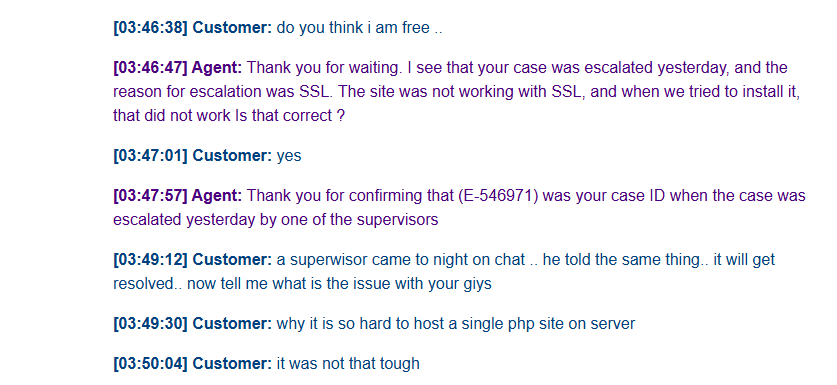
The escalation took one button click, and the chat routed me to Sharath, who confirmed my account type before answering.
His response covered the two scenarios that matter for this question:

That is the right answer and the right level of detail. He addressed both interpretations of my question rather than picking one and missing the other, and the response was specific to the actual product I was on, not a generic script.
The knowledge base is well-organized and covers WordPress-specific topics in depth alongside VPS setup, configuration, and troubleshooting.

Articles include step-by-step procedures with code snippets where relevant, and the categorization makes it easy to find what you need before opening a chat.
The support experience flowed cleanly from AI to human, and both stages did what they should:
The knowledge base covers both products in useful depth and works well as a first stop. For non-urgent questions, the AI layer plus the knowledge base will usually get you where you need to go.
For anything technical or time-sensitive, the one-click escalation to a human works exactly as you would want it to, and the human agent gave a product-specific answer rather than reading from a script.
After testing Bluehost on both managed WordPress and a Self-Managed VPS, the platform delivers cleanly on what it markets.
The WordPress site posted 91% Performance with a 1.1s LCP and 0ms TBT, and the VPS held strong across every benchmark with zero stress test failures across both rounds.
What I appreciated most was the cohesion across both products. Instances like the..
That said, the promotional pricing applies only to the first term, with renewal rates meaningfully higher. Build that into your budget before signing up.
For WordPress site owners who want a managed environment and developers who want a self-managed VPS with current-generation hardware, Bluehost delivers. No reservations on my end.


Yes. The Bluehost AI builder generates three unique site options from a plain-language description of your business. It produces distinct layout, copy, and content structures for each option rather than minor variations of the same template. A Regenerate option is available if none of the initial options match your vision.
Yes. All three Standard plans include a free domain for the first year. The domain selection step appears after plan selection, and a Choose domain later option is available if you want to skip that step during initial signup.
WonderSuite is Bluehost’s WordPress-integrated visual editor. It uses WonderBlocks, a library of pre-built content sections, to let you customize your site by adding, removing, and configuring sections visually. The editor runs inside WordPress, so the full WP admin panel remains accessible alongside it.
No. The AI setup handles the site structure, content, and plugin installation automatically. WonderSuite provides visual editing controls without requiring any WordPress or coding knowledge. The full WordPress admin panel is available for users who want advanced configuration, but it is not required to build and publish a site.
The eCommerce Essentials plan includes WooCommerce auto-install, secure payment processing, product subscriptions, visitor memberships, paid courses, and an affiliate program. The Starter and Business plans do not include eCommerce by default, but the eCommerce add-on is available at checkout on those plans.
Yes. All three Standard plans include a 30-day money-back guarantee on first-time accounts. The guarantee period is the practical window to evaluate the AI builder, WonderSuite editor, and overall platform before the refund option closes.
Data center selection is available at the checkout stage. The options are USA Virginia, Germany Frankfurt, France Paris, Brazil Sao Paulo, Australia Sydney, and USA Arizona. The selected region is where your hosting server will be provisioned.

Answer a few simple questions and find the perfect solution for you!
Start Hosting Search