CGI Hosting Feature Overview
| Provider | Starting Price | Storage (GB) | Bandwidth | Free Domain | |
|---|---|---|---|---|---|
![]() | $2.99 | 100-200 | Unlimited | Yes | Visit Hostinger |
![]() | $1.79 | 15-100 | Unlimited | Yes | Visit Hosting.com |
![]() | $2.49 | 15-40 | Unlimited | Yes | Visit HostArmada |
![]() | $0.59 | 30-100 | Unlimited | No | Visit Verpex Hosting |
![]() | $1.99 | 20-40 | Unlimited | Yes | Visit Neoxea |
![]() | $2.35 | 50-300 | Unlimited | Yes | Visit BoostedHost |
![]() | $1.00 | 10-unlimited | Unlimited | Yes | Visit IONOS |
![]() | $4.00 | 20-4000GB | 5000GB | No | Visit Kamatera |
What are CGI Hosting Providers?
CGI (Common Gateway Interface) Hosting Providers are web hosting services that allow websites to run CGI scripts. CGI scripts are programs, often written in languages like Perl, Python, or PHP, that generate dynamic web content, process form submissions, or handle user interactions on a website. These hosting providers ensure the server environment is configured to execute CGI scripts safely and efficiently, giving website owners more control over custom features and interactive elements.
When to Choose and When to Avoid CGI Hosting
| Reasons to Use CGI Hosting | Reasons Not to Use CGI Hosting |
| You need dynamic web content generated on the server, like forms or calculators. | You are running a simple static website with no interactive features. |
| Your website relies on custom scripts not supported by standard shared hosting. | You are a beginner and prefer hosting that requires minimal setup. |
| You require more control over server-side programming. | You have a very tight budget and cannot pay for a specialized hosting plan. |
| Your site handles user input, such as sign-ups, surveys, or search forms. | You don’t need dynamic functionality and only serve informational pages. |
| You want to experiment with programming languages supported by CGI. | You lack technical knowledge to manage scripts and server permissions. |
If CGI Hosting is Not Relevant to Your Needs, Consider These Alternatives
- Shared Hosting – Ideal for static websites or blogs with low traffic. Affordable and beginner-friendly.
- Managed Hosting – Provides preconfigured servers with automatic updates and security. Good for those who don’t want to manage scripts manually.
- VPS Hosting – Gives full control and the ability to run custom scripts, but may require technical knowledge.
- Cloud Hosting – Flexible and scalable, suitable for websites with fluctuating traffic and dynamic content.
How To Choose the Best CGI Hosting Provider
- Check Script Support – Ensure the host supports the CGI languages you plan to use, such as Perl, Python, or PHP.
- Evaluate Server Configuration – Look for a host that provides proper permissions and environment settings for running scripts safely.
- Match Resources to Needs – Consider CPU, RAM, and storage requirements for your scripts, especially if they are resource-intensive.
- Assess Ease of Use – Choose a provider with a control panel that simplifies script management, backups, and permissions.
- Check Support Availability – Opt for 24/7 customer support in case scripts fail or you encounter configuration issues.
- Compare Pricing and Features – Ensure the plan covers your required scripting functionality without unnecessary costs.
8 Best CGI Hosting Providers in June 2026
-
Best Overall Hosting 2026
-
Users Top Choice 2026
-
Most Recommended NodeJS 2026
-
Best AI App Builder 2026
-
Top 5 Europe Web Hosting 2026

Hostinger’s CGI hosting targets developers and small teams that still rely on Common Gateway Interface scripts for dynamic page generation. It’s a pragmatic fit for budget-minded projects, legacy migrations, and lightweight apps that don’t need a full application framework. With global data centers, solid entry-level performance, and a friendly control panel, it delivers good value while keeping management simple for non-experts.
Rating Overview
Overall Score: 4.5
Performance: 4.6
Support: 4.5
Security: 4.6
Pricing: 4.7
Ease of Use: 4.6
Detailed Analysis
Performance: CGI execution is responsive thanks to optimized web server configs and fast SSD storage. Basic caching and HTTP/2 help static assets load quickly even on busy hours. For CPU-intensive scripts, higher tiers provide more resources to keep response times consistent.
Support: Hostinger’s knowledge base clearly documents CGI paths, permissions, and file ownership considerations. Live chat agents are generally quick to help with common 500 errors and environment variable issues. For complex script debugging, they provide guidance without overreaching into your codebase.
Security: Account isolation, automatic backups, and free TLS certificates protect data in transit and at rest. Malware scanning and server-level firewalls reduce exposure from vulnerable scripts and user input. The platform encourages least-privilege practices with granular file permissions and jailed SSH.
Pricing: Entry plans are aggressively priced and include essentials like SSL, backups, and email. Scaling up remains affordable compared with many managed app hosts. Transparent renewal rates and occasional promos make long-term ownership costs predictable.
Ease of Use: The hPanel interface keeps CGI setup straightforward with clear directories and toggles. One-click features simplify adjacent tasks like database creation and log access. Error logs and metrics are easy to find, speeding up troubleshooting and iteration.
Pros and Cons
Competitive pricing with generous features
Clear CGI documentation and quick live chat
Solid baseline performance with SSD and HTTP/2
Easy backups, restores, and SSL management
Intuitive hPanel for newcomers
Shared plans can throttle under sustained heavy load
Limited deep application profiling tools
Advanced tuning may require higher tiers
-
Top 25 Offshore Hosting 2026

For teams maintaining legacy web applications, hosting.com’s CGI hosting offers a dependable, backwards-compatible environment without forcing a full rewrite. It’s well-suited to agencies inheriting older Perl/Python scripts, universities running research tools, and SMBs with custom in-house utilities. You get a familiar Linux stack, straightforward deployment paths, and sane defaults that balance speed, security, and cost. While it won’t match modern serverless platforms for elasticity, it provides stable performance, predictable billing, and the operational simplicity many long-lived projects need.
Rating Overview
Overall Score: 4.5
Performance: 4.5
Support: 4.7
Security: 4.5
Pricing: 4.4
Ease of Use: 4.6
Detailed Analysis
Performance: CGI processes spin up quickly and benefit from thoughtful resource allocation, so small to medium workloads feel responsive. Optional FastCGI support reduces process overhead and keeps hot paths snappy. Caching at the server layer and SSD storage help steady throughput during traffic bursts.
Support: The support team understands CGI nuances, from shebang quirks to file permission pitfalls. Clear runbooks cover common migration patterns and 500-error debugging. Priority channels respond fast during outages, and knowledge base articles are practical rather than marketing fluff.
Security: Accounts are isolated with suEXEC and sensible permissions to limit cross-site risk. Web application firewalls and malware scanning provide an extra shield for legacy codebases. Regular patching and free TLS certificates encourage secure defaults without extra fees.
Pricing: Plans are sized around CPU minutes, storage, and traffic, which fits predictable projects. The tiers are fair, though bursty, compute-heavy workloads may need an upgrade sooner than on pure VPS. Transparent overage policies keep invoices understandable at month end.
Ease of Use: Deployments are simple: upload, set execute bits, and map handlers. The control panel surfaces logs, environment variables, and cron scheduling in one place. Clear examples for Perl, Python, and compiled binaries shorten setup time for new maintainers.
Pros and Cons
Quick wins for migrating legacy CGI scripts
Helpful, CGI-literate support and practical docs
Solid isolation with suEXEC and WAF options
FastCGI and caching to offset CGI overhead
Predictable billing and clear resource metrics
Less elastic than container or serverless stacks
Compute-intensive apps may outgrow mid-tier plans
Limited appeal for greenfield modern frameworks
-
Best Web Hosting 2026
-
Top 5 Europe Web Hosting 2026
-
Top 5 Germany Web Hosting 2026
-
Top 10 Reseller Hosting 2026
-
Top 5 USA Web Hosting 2025

HostArmada’s CGI hosting focuses on developers and site owners running script-driven apps—think legacy Perl utilities, lightweight Python handlers, or custom PHP scripts that need process isolation. It suits small to mid-size businesses, hobby projects, and agencies maintaining established stacks that still rely on CGI/FCGI endpoints. The value proposition blends modern infrastructure with backward-compatible execution, giving you a safe place to run classic scripts without giving up speed, backups, or an approachable dashboard.
Rating Overview
Overall Score: 4.5
Performance: 4.6
Support: 4.5
Security: 4.5
Pricing: 4.4
Ease of Use: 4.6
Detailed Analysis
Performance: CGI processes spin up quickly and benefit from solid-state storage and optimized web server configs, keeping response times snappy even for older scripts. FastCGI options help reduce fork overhead, improving throughput under moderate traffic. Resource isolation limits noisy-neighbor impact, so your handlers remain responsive during peaks.
Support: Documentation covers enabling CGI, setting shebangs, and correct permissions, which solves most deployment hiccups fast. Live chat and tickets are helpful for troubleshooting 500 errors, environment variables, or path quirks. For tougher cases, staff will often review logs and advise on converting heavy endpoints to FCGI for stability.
Security: Account isolation, permission best practices, and executable-path controls reduce accidental exposure of source files. Automated backups and malware scans add safety if a script is out of date. You still need to patch libraries and avoid world-writable dirs, but the baseline posture is strong for CGI workloads.
Pricing: Plans are competitively positioned considering backups, staging, and SSL are typically included. You can start small and scale up as scripts gain traffic, keeping costs predictable. Renewal rates rise from promo pricing, but the included platform features offset the delta for most teams.
Ease of Use: The panel makes toggling CGI/FCGI and uploading executables straightforward, with file-manager and terminal access when needed. Error and access logs are easy to find, speeding up debugging. Git/SFTP options streamline iterative script updates without complex CI.
Pros and Cons
Easy CGI/FCGI enablement and sane defaults
Helpful docs and responsive chat for script errors
Solid performance for legacy stacks on SSD storage
Clear logs and backups aid fast recovery
Smooth scaling between plan tiers
Renewal pricing higher than intro rates
Strict permissions may trip up first-time CGI users
Not ideal for high-concurrency microservices
-
Best Reseller Hosting Provider 2026
-
Top 5 Australia Web Hosting 2026
-
Top 5 UK Web Hosting 2026
-
Top 10 Windows Hosting 2026
-
Top 10 VPS Hosting 2026

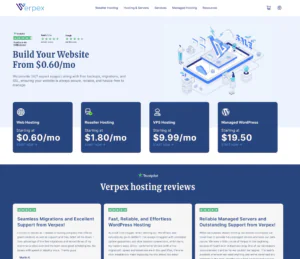
Verpex’s cPanel Cloud Hosting targets creators and small businesses that want simple management with room to scale. The platform blends the familiarity of cPanel and Softaculous with auto-scaling cloud resources, making it a practical choice for agencies managing multiple sites and for solo site owners who prefer a GUI over the command line. Value-wise, Verpex balances performance, tooling, and support well; it isn’t the cheapest bare-bones option, but the bundled features—free migrations, daily backups, and global CDN integrations—make the overall package compelling.
Rating Overview
Overall Score: 4.6
Performance: 4.7
Support: 4.6
Security: 4.6
Pricing: 4.6
Ease of Use: 4.7
Detailed Analysis
Performance: NVMe storage, HTTP/2 (and HTTP/3 where supported), and LiteSpeed/OPcache deliver quick TTFB, while auto-scaling handles traffic bursts without manual tweaks. Resource isolation reduces “noisy neighbor” impact on busy hours.
Support: 24/7 chat/email is knowledgeable on cPanel, migrations, and common CMS stacks; response times are consistently fast, though deep dev-ops topics sometimes require escalations. Clear status updates help during maintenance windows.
Security: Free SSL, automated daily backups, malware scanning, and WAF rules provide a solid baseline. Account isolation and two-factor authentication add safeguards, though niche compliance needs may still require custom hardening.
Pricing: Tiered plans keep costs predictable, and the inclusion of backups and migrations improves ROI. Renewal rates are fair for the feature set, though add-ons like dedicated IPs increase the bill for specialized use cases.
Ease of Use: Classic cPanel plus Softaculous makes site setup turnkey. Staging, one-click restores, and DNS tools streamline workflows; documentation lowers the learning curve for newcomers and agencies alike.
Pros and Cons
Smooth cPanel experience with modern cloud underpinnings
Fast NVMe/LiteSpeed stack for dynamic sites
Free migrations and automated daily backups
Helpful documentation and responsive support
Predictable pricing tiers with useful inclusions
Add-on costs for dedicated IPs and extras
Advanced dev-ops features require workarounds
-
Best Cloud Hosting Provider 2026
-
Over 99% Uptime 2026
-
Great Support 2026
-
Excellent Service 2026
-
Great Support 2025
-
Top 10 WordPress Hosting 2026
-
Great Support 2026
-
Excellent Service 2026
-
Over 99% Uptime 2026

Boostedhost’s CGI hosting focuses on developers and teams maintaining classic web stacks—think Perl, Python, or compiled binaries—while still needing a modern, secure environment. It suits agencies migrating older sites, universities with lab projects, and small businesses running time-tested scripts. The value lies in balanced resources, simple deployment pathways, and sane defaults that don’t get in the way of CGI execution. While it won’t replace containerized platforms, it bridges the gap between legacy workflows and contemporary hosting reliability.
Rating Overview
Overall Score: 4.5
Performance: 4.6
Support: 4.5
Security: 4.4
Pricing: 4.5
Ease of Use: 4.6
Detailed Analysis
Performance: CGI processes spin up quickly with low overhead, and FastCGI options reduce fork/exec penalties on busy endpoints. SSD-backed storage and HTTP/2 help static assets and script outputs feel snappy under bursty loads. Resource isolation minimizes noisy-neighbor issues, keeping latency predictable for form handlers and report generators.
Support: Staff understand the quirks of shebangs, permissions (755/644), and correct interpreter paths, which cuts down trial-and-error. Migration help covers directory structures like cgi-bin, .htaccess rules, and environment variable mapping. Knowledgebase articles show working samples for Perl, Python, and compiled CGI, speeding first-run success.
Security: Chroot-style isolation and user-level permissions contain scripts, and execution policies reduce the blast radius from misbehaving binaries. Automatic patching and WAF rules block common input attacks on query strings. That said, CGI’s nature means careful validation is still required, so advanced hardening may need custom rules.
Pricing: Tiered plans align CPU minutes and memory with typical CGI usage, avoiding overpaying for idle daemons. Transparent scaling lets you step up for seasonal spikes without long contracts. Bundled email and backups add fair value for small teams.
Ease of Use: One-click interpreter selection and preset directory mappings remove setup friction. Clear logs (stderr/stdout) surface in a centralized viewer, making debugging faster than tailing scattered files. Git or SFTP deploys keep familiar workflows intact, with minimal platform lock-in.
Pros and Cons
Quick setup for cgi-bin and FastCGI
Practical docs and sample scripts ready to adapt
Predictable performance under bursty form traffic
Helpful support familiar with legacy stacks
Sensible pricing with upgrade flexibility
Advanced security hardening may require manual tuning
Not ideal for highly modern, containerized stacks
Limited upside for heavy real-time workloads
-
Best Value for Money 2026
-
Editor's Choice 2026
-
Most Recommened PHP Hosting 2026
-
Top 5 UK Web Hosting 2026
-
Top 5 Europe Web Hosting 2026

Ionos offers CGI hosting as part of its mainstream shared and business web hosting plans, making it a practical choice for teams maintaining legacy Perl/Python/PHP scripts or lightweight gateways that still rely on the Common Gateway Interface. The platform focuses on stability, predictable performance, and broad compatibility, which suits SMEs, universities, and developers needing a reliable environment for established workflows. While it won’t match the speed or developer comfort of modern containerized stacks, Ionos balances cost, security hardening, and ease of deployment for projects where CGI remains the simplest path.
Rating Overview
Overall Score: 4.5
Performance: 4.6
Support: 4.4
Security: 4.6
Pricing: 4.7
Ease of Use: 4.5
Detailed Analysis
Performance: CGI execution is snappy for small to medium scripts, aided by SSD-backed storage and solid baseline resources. Concurrency is adequate for departmental sites and internal tools, though heavy fork-per-request workloads can hit limits on shared tiers. Caching and static offload help keep response times consistent.
Support: Ionos provides 24/7 assistance and clear setup docs for CGI paths, permissions, and shebangs. Support is knowledgeable on common pitfalls like file modes and environment variables. Deep optimization or language-specific tuning guidance can be limited compared to developer-focused hosts.
Security: Account isolation, default restrictive permissions, and automated patching reduce common CGI risks. Free SSL/TLS and WAF options help protect form handlers and older codebases. As with any CGI stack, secure coding and periodic audits remain essential to avoid injection or file exposure.
Pricing: Plans are competitively priced and include domains, SSL, and email, keeping total cost low for legacy workloads. Transparent tiers let you scale storage and processes without a steep jump. For bursty, compute-heavy scripts, upgrading to higher tiers may be necessary.
Ease of Use: Deployment is straightforward via FTP/SFTP with standard cgi-bin conventions. Log access and error reporting make debugging practical, and cron support simplifies recurring tasks. The control panel is clean, if not developer-centric, and integrates most basics in a few clicks.
Pros and Cons
Budget-friendly entry with generous inclusions
Stable environment for legacy Perl/Python/PHP scripts
Simple deployment using familiar cgi-bin structure
Useful logging and SSL/WAF options for safer operation
Reliable uptime for departmental and SME use
Not ideal for high-concurrency or modern microservices
Limited advanced developer tooling and build pipelines
Performance tuning options trail VPS/containers
-
Best VPS Hosting 2026
-
Top 5 Europe Web Hosting 2026
-
Top 5 Australia Web Hosting 2026
-
Top 10 Best Gaming Hosting Provider 2026
-
Top 10 Reseller Hosting 2026

Kamatera’s cPanel Cloud Hosting brings the company’s well-known elastic cloud to a familiar control-panel experience. It’s a strong fit for developers, agencies, and SMBs that want global data center choice, quick scaling, and predictable admin workflows via cPanel/WHM. Value comes from granular resource controls and pay-as-you-use pricing, though you’ll get the most from Kamatera if you’re comfortable managing server configurations rather than expecting a fully hands-off service.
Rating Overview
Overall Score: 4.6
Performance: 4.8
Support: 4.5
Security: 4.6
Pricing: 4.5
Ease of Use: 4.5
Detailed Analysis
Performance: Kamatera’s SSD-backed instances and flexible CPU/RAM profiles deliver consistently low latency, especially when you place workloads in one of its multiple global regions; vertical scaling without migration helps you right-size quickly during traffic spikes.
Support: 24/7 chat and ticketing are responsive with practical guidance on cPanel/WHM tasks; deeper architecture help is available but may incur add-on costs, so factor that in if you need frequent hands-on assistance.
Security: Baseline protections include network firewalls, private networking, and snapshot backups; compliance-minded users can layer IP whitelisting and monitoring, though you remain responsible for hardening cPanel, patching, and backup policies.
Pricing: Transparent hourly/monthly billing with fine-grained resource sliders keeps budgets in check; cPanel licensing and optional managed services add to the bill, but the control over specs often offsets waste from overprovisioning.
Ease of Use: The deployment wizard and WHM onboarding make initial setup quick; advanced controls are powerful yet assume some sysadmin comfort, so beginners may face a learning curve configuring DNS, backups, and security rules.
Pros and Cons
Elastic scaling without migrations
Global regions for better latency
Familiar cPanel/WHM workflow
Transparent, granular pricing
Snapshot and firewall options
Management overhead for beginners
Add-on costs for managed tasks
Licensing adds to total price
Why Trust Our Recommendations
At HostAdvice, trust and transparency are central to our reviews. We combine deep hosting expertise with real user feedback to provide reliable guidance. Our goal is to help you confidently choose the CGI hosting solution that fits your needs while avoiding unreliable or limited providers.
How Do We Test and Rank
We conduct extensive research to identify the best CGI hosting providers and their key features. Our experts test hundreds of plans in real-world conditions, setting up scripts, monitoring uptime, and measuring performance. We focus on real-time results, transparency, and reliability, ensuring that the hosting providers we recommend deliver what they promise. Our ranking system rewards providers who maintain consistent uptime, responsive support, and secure scripting environments.
Final Recommendations
CGI hosting is essential for websites that need dynamic content, user input processing, or custom scripting capabilities. When selecting a provider, focus on script support, server configuration, and resource availability. With the right hosting, your website can run interactive features smoothly, remain secure, and handle user traffic efficiently.