


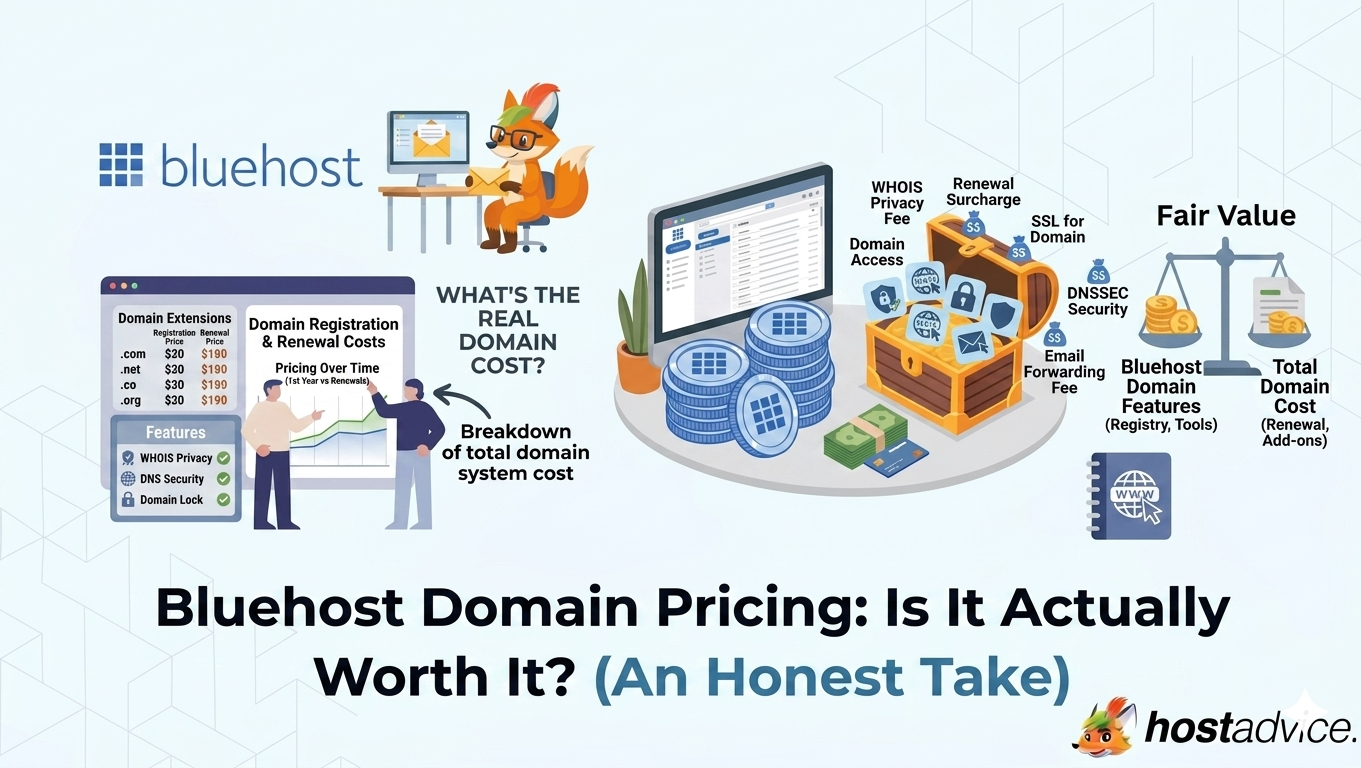
You’re trying to register a domain. Maybe it’s for a new website, a business idea, or a client project that needs a reliable online presence.
Then you come across Bluehost.
At first glance, the pricing looks straightforward. Core extensions like .com, .net, and .org are clearly listed, and there are no extreme discounts or confusing promotional pricing.
But that simplicity is only surface-level.
Because what Bluehost does differently isn’t aggressive pricing. It’s how that pricing is positioned.
The first-year cost is relatively stable, renewal rates are predictable, and domains are often bundled with hosting rather than sold as standalone deals.
To understand whether it’s actually worth it, you need to look beyond the first number you see and evaluate how pricing behaves over time.

Key Takeaways
Here’s the quick version before you compare Bluehost domain pricing, renewal costs, bundled value, and add-ons.
- Pricing is stable rather than aggressively discounted: .com domains start at ~$12.99/year without extreme promotional pricing.
- Renewal pricing defines long-term cost because Bluehost keeps prices more predictable over time.
- Domain value is tied to hosting bundles, with many plans including a free domain for the first year.
- Extension choice impacts both pricing and branding. Standard TLDs are more consistent, while niche domains usually cost more.
- Fewer promotional tricks mean clearer pricing, so what you see upfront is closer to what you pay long term.
- Overall value is convenience-focused. Bluehost simplifies domain and hosting setup rather than minimizing domain cost.
Understanding the Bluehost Domain Pricing Landscape
Bluehost domain pricing makes more sense when you look at its focus on simple setup, hosting bundles, and predictable long-term costs.
Why Bluehost Stands Out in the Domain Market
Bluehost approaches domain pricing differently compared to traditional registrars.
Instead of focusing purely on selling domains, it builds its value around an integrated ecosystem that includes hosting, domains, and website tools.
This changes how pricing should be evaluated.
You’re not just buying a domain. You’re buying into a system that makes it easier to launch and manage a website without needing multiple providers.
For beginners, this reduces setup complexity. For experienced users, it offers convenience rather than control.
This is a key distinction.
Where domain-first providers compete on price and features, Bluehost competes on simplicity and integration.
The Evolution of Bluehost’s Domain Pricing Model
Domain pricing across the industry has evolved toward aggressive entry pricing and higher renewals.
Bluehost takes a more balanced approach:
- Entry pricing is moderate rather than extremely discounted.
- Renewal pricing is closer to standard rates.
- Domains are frequently bundled with hosting plans.
This creates a different user experience.
Instead of attracting users with ultra-low first-year prices, Bluehost keeps pricing more consistent from the start. The trade-off is less upfront savings, but fewer surprises later.
What This Means for Your Decision

Bluehost is not trying to be the cheapest domain registrar.
Instead, it is designed for users who want a simplified experience where domains and hosting are managed together.
If your priority is ease of setup and convenience, this model works well. If your priority is minimizing long-term cost across multiple domains, you need to evaluate pricing more carefully.
If you’re still deciding, it can also help to read our in-depth Bluehost review to better understand how its domain and hosting ecosystem perform in real-world use before making a final decision.
Pricing Breakdown of Bluehost Domain Extensions
Bluehost offers a focused set of domain extensions with straightforward pricing. Unlike heavily discounted providers, the emphasis here is on consistency rather than aggressive entry pricing.
Understanding how each extension is positioned helps you choose based on branding, budget, and long-term use.
You can also take advantage of Bluehost coupons, where available, to reduce your upfront cost, especially when registering domains alongside hosting plans.

Here’s what the main domain extensions look like:
| Domain Extension | Starting Price | Best For | Main Limitation |
|---|---|---|---|
| .com | ~$12.99/year | Businesses, startups, long-term branding | High competition and limited availability |
| .net | ~$18.99/year | Tech platforms, SaaS projects | Lower brand recall compared to .com |
| .org | ~$14.99/year | Nonprofits, communities, educational sites | Not ideal for commercial-first businesses |
| .co | ~$29.99/year | Startups, personal brands | Higher pricing and possible confusion with .com |
| .blog | ~$22.99/year | Bloggers, content creators | Narrow use case |
| .website | ~$29.99/year | General websites, testing ideas | Weak memorability and higher cost |
.com
Starting price: ~$12.99/year
The .com extension is the most widely recognized and trusted domain globally. It is the default choice for businesses and long-term projects because of its credibility and familiarity.
Pricing is stable compared to promotional providers, but availability is often limited.
Ideal for: Businesses, startups, long-term branding
Limitation: High competition and limited availability
.net
Starting price: ~$18.99/year
The .net extension is a common alternative to .com, especially for tech-related or infrastructure-focused projects.
It offers a professional tone but lacks the universal recognition of .com.
Ideal for: Tech platforms, SaaS projects
Limitation: Lower brand recall compared to .com
.org
Starting price: ~$14.99/year
The .org extension is associated with nonprofits, communities, and mission-driven organizations.
Pricing is relatively stable, making it a reliable long-term option.
Ideal for: Nonprofits, communities, educational sites
Limitation: Not ideal for commercial-first businesses
.co
Starting price: ~$29.99/year
The .co extension is popular among startups and modern brands. It offers flexibility in branding but comes at a higher cost.
Ideal for: Startups, personal brands
Limitation: Higher pricing and possible confusion with .com
.blog
Starting price: ~$22.99/year
The .blog extension is designed for content creators and niche websites.
It clearly communicates purpose but is limited in flexibility.
Ideal for: Bloggers, content creators
Limitation: Narrow use case
.website
Starting price: ~$29.99/year
The .website extension is a general-purpose option with broad applicability.
However, it lacks a strong branding impact.
Ideal for: General websites, testing ideas
Limitation: Weak memorability and higher cost
Key Insight: Starting Price vs. Real Cost
The price you see upfront is not the full cost of owning a domain.
In Bluehost’s case:
- The first-year price is not heavily discounted.
- Renewal pricing is consistent but still recurring.
- Add-ons can increase yearly cost.
This means your total investment is defined by how long you keep the domain, not how cheap it is initially.
Compared to promotional providers, Bluehost reduces price shock but does not eliminate long-term cost considerations.
Features That Influence Bluehost Domain Pricing
A few key factors shape what you pay, including the extension, renewal rate, privacy options, and bundled services.
Domain Extensions and TLD Pricing
Different domain extensions come with different pricing structures. Popular domains like .com are more stable, while niche extensions often carry higher costs due to lower supply and more targeted use cases.
This makes pricing vary not just by demand, but also by how the extension is positioned in the market.
Beyond pricing, extension choice directly impacts branding and trust. A .com domain is easier to recognize and remember, while newer TLDs may require more effort to establish credibility.
- Standard TLDs: More stable pricing and stronger recognition.
- Niche TLDs: Higher cost but more targeted positioning.
Introductory Pricing vs. Renewal Rates
Bluehost does not rely heavily on ultra-low introductory pricing. This results in a smaller gap between first-year and renewal pricing compared to competitors, where prices often jump significantly after the first term.
This creates more predictable long-term costs. Instead of focusing only on short-term savings, Bluehost’s pricing model helps you estimate ongoing expenses more accurately, which is especially important for business or long-term projects.
Domain Privacy and Security
Domain privacy protects your personal information from public databases like WHOIS, preventing your name, email, and contact details from being exposed. This is particularly important if you want to avoid spam or protect business-related contact details.
With Bluehost, this is not always included by default and may increase your total cost. However, it adds a layer of protection that goes beyond privacy.
- Reduces spam and unsolicited contact.
- Helps prevent phishing and data scraping risks.
Domain Management and Control
Bluehost provides a centralized dashboard where you can manage domains, DNS settings, renewals, and transfers in one place. This simplifies the process, especially for users who are not familiar with technical configurations.
While this improves usability, it is designed for convenience rather than advanced control.
- Easy access to DNS and domain settings.
- Simplified interface for beginners.
- Limited advanced customization compared to specialized registrars.
Bundled Services and Upsells
During checkout, Bluehost may present additional services that are designed to enhance your setup rather than being required for domain ownership. These can improve functionality but also increase your total cost if selected.
These typically include:
- Email hosting: Professional email tied to your domain.
- Website tools: Builders or integrations for launching quickly.
- Security features: Add-ons like backups or protection tools.
These options are useful, but not essential. Reviewing them carefully helps you avoid unnecessary spending while still choosing what adds real value to your setup.
Core Features Included with Bluehost Domains
Bluehost includes several built-in features that impact how your domain functions beyond pricing. These features are designed to simplify management rather than expand control.
Easy Domain Management
Bluehost provides a centralized interface where you can manage domains, DNS records, renewals, and configurations.
This is particularly useful for beginners who may not be familiar with technical domain settings.
Instead of navigating multiple dashboards, everything is handled in one place.
Domain Forwarding
Domain forwarding allows you to redirect one domain to another.
This is useful for:
- Managing multiple domain variations.
- Redirecting traffic during rebranding.
- Consolidating brand identity.
Without forwarding, each domain would require separate setup.
Auto-Renewal
Auto-renewal ensures your domain does not expire accidentally.
This is critical because expired domains can be purchased by others, especially if they have value.
Auto-renewal prevents loss but introduces automatic billing, which should be monitored.
Domain Lock
Domain lock prevents unauthorized transfers.
It adds a layer of security that ensures your domain cannot be moved without your permission.
This is especially important for business websites or high-value domains.
Expert Support
Bluehost offers support for domain-related issues such as DNS configuration and domain transfers.
This is valuable for users who may not have technical expertise.
The Trade-Off: What Bluehost Doesn’t Include
To keep pricing straightforward, certain features are not always included by default.
These may include:
- Free domain privacy in some cases.
- Advanced DNS customization tools.
- Lower promotional pricing.
- Bulk domain management features.
This approach prioritizes simplicity over flexibility.
Hidden Costs and Add-Ons That Affect Total Pricing
The domain price is only part of the budget, so it helps to review renewals, privacy, email, and auto-renewal settings.
Renewal Costs
Renewal pricing applies every year after the first term and becomes the main cost over time.
Domain Privacy
If not included, privacy protection adds recurring cost.
Email and Extras
Professional email and additional tools may increase your total spending.
Auto-Renewal Charges
Auto-renewal prevents expiration but can lead to automatic billing if not monitored.
Bluehost vs. Competitors: Pricing Comparison
Bluehost does not compete directly on pricing. Compared to Namecheap, it is more expensive upfront and over time, especially when domain privacy is included.
However, Namecheap is built specifically for domain management, which makes it more cost-efficient but less integrated.
Against GoDaddy, the difference is less about price and more about experience. Both sit in a similar pricing range, but Bluehost offers a cleaner, less aggressive checkout process, while GoDaddy tends to rely more heavily on upsells and add-ons.
Here’s how the main differences compare:
| Feature | Bluehost | Namecheap | GoDaddy |
|---|---|---|---|
| .com Starting Price | Moderate (~$12.99) | Lower (~$5–$10) | Moderate |
| Renewal Pricing | More stable and predictable | Lower and more consistent | Moderate to high |
| Domain Privacy | Paid add-on in most cases | Free included | Paid add-on |
| Ease of Use | Very beginner-friendly and integrated | Simple and domain-focused | Easy but upsell-heavy |
| Checkout Experience | Clean and hosting-oriented | Transparent with minimal upsells | Frequent upsells and add-ons |
| Best For | Users bundling domain and hosting | Budget-focused domain buyers | Users already in the GoDaddy ecosystem |
The key distinction is positioning.
- Bluehost: Built for simplicity and bundled setup.
- Namecheap: Built for cost efficiency and domain control.
- GoDaddy: Built for brand familiarity and broad ecosystem.
This means Bluehost is not trying to win on the lowest price. It is designed for users who want a smoother setup experience where domains and hosting work together without extra configuration.
If your priority is minimizing cost, Bluehost is not the strongest option. If your priority is reducing setup complexity, it becomes much more competitive.
Final Verdict: Is Bluehost Domain Pricing Worth It?
Bluehost domain pricing is built around simplicity and predictability rather than aggressive discounts.
The pricing is not the lowest, but it is easier to understand and manage over time.
If you want a simple, all-in-one setup, Bluehost is a practical choice.
If your goal is to minimize long-term domain costs, you may find better value with a dedicated registrar.
Conclusion
Bluehost makes the most sense when domain registration is part of a larger website setup. Its pricing is not designed for bargain hunters or bulk domain buyers, but it works well for users who want fewer moving parts.
The strongest value comes from convenience. You can register a domain, connect hosting, manage settings, and launch a website from the same account.
For long-term ownership, though, renewal pricing and add-ons still matter. Before buying, compare your total cost over several years rather than focusing only on the first-year price.
Next Steps: What to Do Before You Buy
Use these quick checks to choose the right extension, compare long-term costs, and avoid paying for extras you do not need.
- Choose the right extension: Use .com or .net for long-term credibility, or niche TLDs for branding.
- Check renewal pricing: Focus on long-term cost, not just the first-year price.
- Review add-ons carefully: Privacy, email, and extras can increase total cost.
- Consider hosting bundles: A free domain can reduce your first-year expense.
- Secure your domain early: Strong names get taken quickly.
