Basfae44’sbiggest strength is also its biggest weakness. That seamless experience comes with real trade-offs: free credits burn fast (one complex feature can drain 5-8 credits), the proprietary database makes migration difficult, API integrations require the $50/month Builder plan, and developers who want code-level control hit walls quickly.
We’ve tested the leading alternatives, from visual builders like Bubble to AI-native platforms like Lovable and a user-friendly platform with round-the-clock support like GoDaddy Airo.
Each excels in different scenarios: full code ownership, better pricing, specialized features, or frameworks that Base44 doesn’t support.
Unlike Base44’s proprietary all-in-one approach, Lovable generates production-grade React and TypeScript code you fully own from day one, with seamless GitHub integration that lets developers export, extend, or migrate projects without platform lock-in.
Built-in Full-Stack Infrastructure
Lovable scaffolds full-stack apps with Supabase backends, Stripe payment flows, and role-based authentication, all managed through natural language prompts.
While Base44 also offers built-in full-stack features, the trade-off makes the difference. On Base44, users are locked behind paid plans, and compared to Lovable’s 100+ verified connections, Base55 has only 15.
Visual Editing Without the Guesswork
What makes Lovable particularly compelling is its “Select & Edit” visual mode. You can click any element on your preview canvas, describe changes in plain English, and watch updates render in near real-time.
Prototyping Speed
It’s 20x faster than traditional coding for prototyping work, according to developer reports.
Flexible and Predictable Pricing
The credit-based system also feels more generous than Base44’s structure. Where Base44 burns through message credits quickly on complex features (5-8 credits per detailed request), Lovable’s Pro plan offers 100 monthly credits plus 5 daily refreshes (up to 150/month total), with credits scaling predictably to task complexity.
Open System Production
More importantly, you’re building on open technologies (React, Tailwind, Supabase), rather than a closed ecosystem.
Choose Lovable if you want code ownership, flexible deployment options, and the ability to transition to custom development later.
It’s the smarter long-term bet for projects with scaling ambitions or technical teams, while Base44 remains better for pure beginners who prioritize all-in-one simplicity over portability.
Best for: Founders and technical users who care more about code quality and scalability than speed.
Category
Details
AI Model
Claude 4.0 Sonnet (Default), GPT-5 (Beta), Ultra Thinking
Primary Stack
React (Frontend) + Fast API (Backend) + PostgreSQL/MongoDB
Starting Price
Standard – $20/month; Comes with 100 credits
Free Tier
Yes – 5 credits per month; no credit required for tryouts
Code Access
Allows full code export to GitHub
Core Strength
Designed to build complex full-stack applications with automated testing and managed infrastructure at scale.
Best Use Cases
Web applications, MVPs, prototypes.
Why Emergent AI Stands Out as a Base44 Alternative
While both tools promise scalable, functional results, they’re individually better suited for different purposes. One is made for speed, while the other focuses on quality.
Here are five key ways Emergent stands out as a great alternative to Base44:
Multi-Agent Development vs Single AI Generation
Base44 uses a single AI model to handle the entire app generation process. While beginner-friendly, Emergent offers a more sophisticated approach.
Here, different AI models are allocated for varying roles. For example, you can use ‘Claude’ for prompt response, ‘GPT-5’ for designing, and ‘Ultra Thinking’ for deep reasoning. This mode exemplifies the nature of software engineering in a highly operative team.
Open Stack vs Proprietary Backend
While Base44 automates the entire backend setup, it also runs all its operations on a proprietary system. Therefore, you do not outrightly own or control the backend of your application. You can export and self-host, but the backend’s core functionality still resides on Base44 servers. Hence, if the platform shuts down, your app will too.
Emergent, on the other hand, runs on an open, industry-standard technology. You own the entire codebase outright, and you can export to GitHub and self-host on AWS, Vercel, or DigitalOcean. Hence, no vendor-lock-in.
Non-Restricted Code Ownership
Unlike Base44, which restricts integration and deployment to paid plans, you’ll get free access to it on Emergent. You can easily generate and deploy a functional app on the Emergent free plan without worrying about payment restrictions.
This also applies to code editing on Emergent. While Base44 locks this feature for its paid plan, you’ll get full access to Emergent’s browser-based VS Code editor on its free plan.
Automatic Structured Testing
Base44’s testing feature keeps things simple and functional. It’s a great initiative for beginners because it handles errors automatically. However, Emergent takes it a step further by running structured tests on the finished application (frontend and backend).
In other words, by the time you’re done building, Emergent checks for errors in every base to ensure all operations are functional. This breeds more confidence and certainty for every user.
Bigger Integration Capabilities
With about 15 pre-built templates and custom API connections available only on paid plans, Base44 is better suited for simple projects. When it comes to complex applications, that’s where it hits an edge.
Emergent handles integration seamlessly. From Stripe to database setup, Emergent can manage the entire integration process right from your first prompt. No back and forth required. No manual configuration necessary.
VerdictIf you need more than just a prototype, Emergent is a great choice. Base44 is quicker and simpler to use, but Emergent offers an approach that promotes long-term scalability.
Key Strengths
Access to the full VS Code editor from the browser. You can inspect, edit, and debug the entire codebase right from the editor.
Clean and exportable code that you can hand off to another developer to extend, refactor, or scale without any hassle.
A multi-agent development system promotes better code quality and variation, compared to a single-agent model.
One-click deployment to a live subdomain with custom domain support.
Structured automated frontend and backend testing on the finished application.
Full code ownership and self-hosting to AWS, Vercel, and DigitalOcean.
Best suited for complex, scalable projects compared to building simple prototypes on Base44.
Potential Limitations
Free tier credits (5/per month) aren’t sufficient for building a real, functional application.
Hosting is expensive. It costs an additional 50 credits per month.
No drag-and-drop visual editor. Edits are either made via prompts or code.
Emergent AI vs Base44: Key Similarities and Differences
One-click to Emergent subdomain; custom domain support
One-click to Base44 subdomain; custom domain on paid plans
Emergent vs Base44: Bottom Line
Emergent is a smart alternative if you’d like a production-ready application with automated error testing built in, open-system technology, and full ownership of the code. It’s a great choice for long-term, scalable projects.
On the other hand, Base44 offers a quick and simple advantage. If you need to validate an idea quickly without the hassle of setting up backends or dealing with errors, Base44 is a great choice.
Best for Production-Ready Applications With Automated Error Testing
Best for: Non-technical users looking to build simple, yet functional applications without writing a single line of code.
Hostinger horizons Features
Details
AI Model
Not disclosed (likely GPT-4 class)
Primary Stack
Clean React + Tailwind
Starting Price
Explorer – 30 messages/month (RM 43.99 or $6.99/Per Month)
Free Trial
7-day free trial (5 messages)
Core Strength
Simple and best suited for new/non-technical users; generates fully functional applications from prompts
Best Use Cases
Prototypes – web applications, landing pages, etc.
What Sets Hostinger Horizons Apart?
Hostinger Horizons and Base44 are AI-powered platforms that promise to build applications without needing the technicality. While this isn’t far-fetched, the difference between the two tools is, however, in the process and result.
The Bundled Value is a Differentiator
One thing that sets Hostinger Horizons apart, beyond Base44, is its bundled value. Base44 is a standalone tool. When it comes to hosting, custom domains, and business emails, these are features that are either purchased externally or require a higher-tier upgrade for access.
Hostinger Horizons, however, offers these features as a bundled value. For example, an entry-level plan gets you one free custom domain, one month of hosting, business email, and security features. This is a great advantage for users who want everything handled in just one place, without extra hassle.
Simpler Workflow
Base44 offers multiple ways to build applications, from code editing to a visual editor and prompts. While this is a huge advantage, beginners can quickly get overwhelmed or confused with the workflow.
Hostinger Horizons keeps it easy. With a single prompt, the AI can build, fix, and manage everything you need. This makes things simple and beginner-friendly for non-technical users.
Interactive Live Preview That Actually Works
If you’ve previously used a code builder and had to keep switching between the editor and preview modes to confirm changes, you’ll understand how inconvenient it is.
Hostinger Horizons offers this feature to help users see changes in the preview mode immediately. You can test, manage pages, toggle between dark/white modes, spot issues in real time, all before you click the “Publish” button.
This is a great initiative, and it’s something Base44 currently does not offer.
Most Affordable Entry Point
Hostinger Horizons is known as one of the most budget-friendly no-code tools. With just $6.29/month, you can build your first application. Compared to Base44’s starting price ($16/month), I’ll say this is a big advantage, especially when the Horizons’ bundled value is factored into play.
However, pay attention to your usage on Hostinger Horizon. It can quickly get exhausted on little fixes. However, with the right setup, the starter plan is enough to create a simple project.
Hostinger Horizons is a great pick if you’re a complete beginner, solopreneur, or small business owner. With this tool, you’ll get the simplest and most affordable means to build a live project without coding.
On the other hand, Base44 makes better sense for complex projects, or if you want broader access to the integration catalog, or prefer automatic backend, or code editing features.
When making your choice, start by weighing your options and seeing which makes better sense for your needs.
build simple yet functional applications without coding
Powerful built-in backend with privacy rules and database trigger actions.
Deployment Options
Dev/Live environments on AWS; supports custom domain on paid plans
Core Strength
Built to generate more than just prototypes; requires a steeper learning curve compared to other no-code builders.
Best Use Cases
Marketplaces; Multi-user product; SaaS applications, etc.
How Does Bubble.io Stand Out as an Alternative to Base44?
Deciding between Bubble.io and Base44 comes down to speed versus flexibility. While both tools are designed to generate functional apps from ideas, each takes very different paths.
One focuses on creating fully managed end-to-end applications, while the other dwells on granular control and flexibility for complex projects.
However, here are five reasons Bubble.io stands out as a great alternative to Base44.
Flexibility & Control
When it comes to pixel-perfect control, Bubble dominates the realm. Bubble allows you to drag and drop any component to the canvas, resize it, set alignment rules, assign CSS classes, control how it looks on various screen sizes, and much more. Every element has a “Property Editor” that allows users to tweak texts, styles, borders, and even SEO tags.
On the other hand, Base44 offers a more prompt-based generation setup. You describe what you want from the AI, and it designs it. For simple projects, this works well. But when it comes to specific adjustments, it can be a bit challenging.
Best for Production-Grade Applications
Bubble AI app builder is well-known for producing production-ready applications that have scaled multiple businesses, handled millions of transactions, and supported thousands of users. Since it runs on AWS infrastructure, solidity and firmness are its watchwords.
Base44, however, is known for generating prototypes and MVP tools. It’s best used for validating concepts and demonstrating workflows. It ultimately lacks the robust infrastructure required for a production environment, which Bubble offers.
Visual Workflow Builder for App Logic
Unlike Base44, which automatically sets up app logic based on prompts, the Bubble AI app builder takes a broader approach.
Here, you can systematically define your application logic. Without writing any code, you can design trigger events, add conditions, set up branching logic, or handle errors brilliantly.
In essence, while Base44’s approach is fast, it can also quickly get inconvenient when there are no right words to describe your intent, or you’re trying to focus on a specific part of the app.
Plugin Marketplace with 6,000+ Options
Bubble offers thousands of free and paid plugin options covering payments, AI, analytics, file uploader, customer support, media, and more.
The best part about this is that you don’t necessarily have to rely on available plugins. While you’re most likely to find what you need, you can also build and publish your own if you’d like.
Base44 has around 15 pre-built integration options, with custom API connections only available on paid plans. For a simple project, this can be sufficient, but beyond that, it’ll seem limiting.
A Debugger That Sets The Standard
Bubble has a dedicated step-by-step debugger that is automatically activated every time the application is in “Preview” mode.
This feature runs every action one by one and inspects what’s wrong at every stage, tests workflow actions in real time, knows what conditions were executed, and knows exactly where something breaks. This is similar to when a developer steps into an IDE to identify and fix issues.
Base44 also has an automatic error detection and fix feature, which is helpful for non-technical users. However, Bubble supports a broader approach.
Note Base44 is built for speed and simplicity. Bubble is designed to handle real SaaS products or marketplace applications with heavy traffic. In essence, your objective determines your choice.
Key Strengths
Supports full visual drag and drop editor with pixel-perfect design control.
Built-in database and data modeling with privacy rules. Requires no external service as everything is managed inside the Bubble workflow.
Provides a plugin marketplace with over 6,000 options. It covers AI, analytics, payment, media, etc.
Define workflow automation for app logic without writing a single line of code.
Generates native mobile apps that you can publish directly on iOS and Android.
Integrated debugger for workflow actions.
Supports API connector for external services.
Potential Limitations
Steeper learning for advanced options
The free plan doesn’t allow publishing
Workload-based pricing can keep the total cost hard to predict as the app grows.
Choose the Bubble AI app builder if pixel-perfect design, logic control, and scalability are important to you. Bubble is a perfect option for long-term, scalable applications with heavy user traffic.
On the other hand, Base44 is a better option if you’re a solo founder, creator, or beginner trying to quickly validate a concept. Its six-minute app generation, automatic backup and error fixes, and lower pricing make it better suited for simple prototypes and MVPs.
Production-grade applications with broader control and flexibility
Best for: Small business owners, entrepreneurs, and solopreneurs who want to launch quickly and at a low cost.
GoDaddy Airo features
Details
AI Model
Proprietary AI (no model selection)
Free Plan
Yes (50 AI credits/month) No credit card required
Starting Price
$9.99/€8.49 (Billed annually)
Code Access
Code can be downloaded on all plan tiers
Deployment
One-click publish to GoDaddy’s hosting
Core Strength
Build web applications within minutes; cheaper entry to the AI app building process; reliable hosting and uptime security.
Best Use Cases
Simple business websites and web applications
Why GoDaddy Stands Out as an Alternative to Base44
While both platforms generate applications using prompts, they, however, target different problems. Base44 is known to build product-like applications with automatic backend setup, while GoDaddy Airo is more business-focused.
Here are four (4) ways GoDaddy Airo stands out as a great alternative to Base44:
Fastest AI Builder
Base44 is known for its speedy app generation, and while I thought it can’t get any faster, GoDaddy Airo came into play. GoDaddy Airo is the fastest no-code tool I’ve ever tested. It built a life-coaching website (Orionis) for me in under two minutes.
Hence, if getting online quickly matters more to you than the depth of features available, GoDaddy Airo should be a top pick for you.
It’s More Than Just a Website Builder
GoDaddy Airo is more than just a static site generator. It can build web applications with pages, backend logic, forms, and analytics embedded in a single prompt.
Once you type your business description, it builds the entire system, including hosting, SSL, DDoS protection, global edge caching, and automatic backups. It’s all wired in automatically. And once you hit ‘publish’, your website goes live on a real domain with ease.
While Base44 also automatically handles the hosting setup, GoDaddy is well known as the world’s largest domain registrar with over two decades of infrastructural experience. For a small business owner who cares about security, that trust gap is real.
Cheapest Entry Point to AI App Builder
The best part of GoDaddy Airo is that the free plan allows users to build applications with 50 AI credits per month. It also comes with a ‘7-day premium free trial’ which removes the GoDaddy branding, gives you access to a custom domain, advanced marketing tools, and more.
If you’re looking to create a basic business website, GoDaddy Airo lets you launch quickly without necessarily requiring you to pay for a higher-tier plan.
24/7 Support System
Unlike other platforms, GoDaddy Airo offers round-the-clock phone and live chat support with no restrictions on tier category. This means whether you’re on the free plan or the most expensive, you can reach out to the team at GoDaddy for support or inquiries.
On the other hand, Base44 provides dedicated documentation, community support with a Discord server, and offers premium support for users on higher plan tiers.
Hence, if you’re a beginner new to no-code builders and stuck on a technical issue at 3 AM, you can swiftly reach out to the team at GoDaddy Airo for help, compared to trying to find your way to the answer on Base44.
Free plan; paid plan starts at $19.29 or €16.99 per month ($9.99 or€8.49 when billed annually)
Free plan; paid plan starts at $16 per month
Integration
Supports third-party tools such as Stripe, custom APIs, etc., plus GoDaddy’s native ecosystem
Built-in functions – Google Workspace, Notion, Slack, HubSpot, Salesforce, etc.
Support
24/7 phone and live chat support; AI Chatbot assistance; Help Center & Community
Data-packed documentation, community support, partner network, and premium support for higher-tiered users.
GoDaddy Airo vs Base44: Bottom Line
GoDaddy Airo offers the most affordable path into the no-coding industry. With round-the-clock support and a seamless hosting process, GoDaddy Airo is a great way for small business owners and solopreneurs to build web applications in minutes.
Tradeoff: GoDaddy Airo is newer in the industry compared to Base44. Additionally, the AI-generated copy is bland, and the overall result feels ordinary and generic.
Create Your Business Site Using GoDaddy Airo
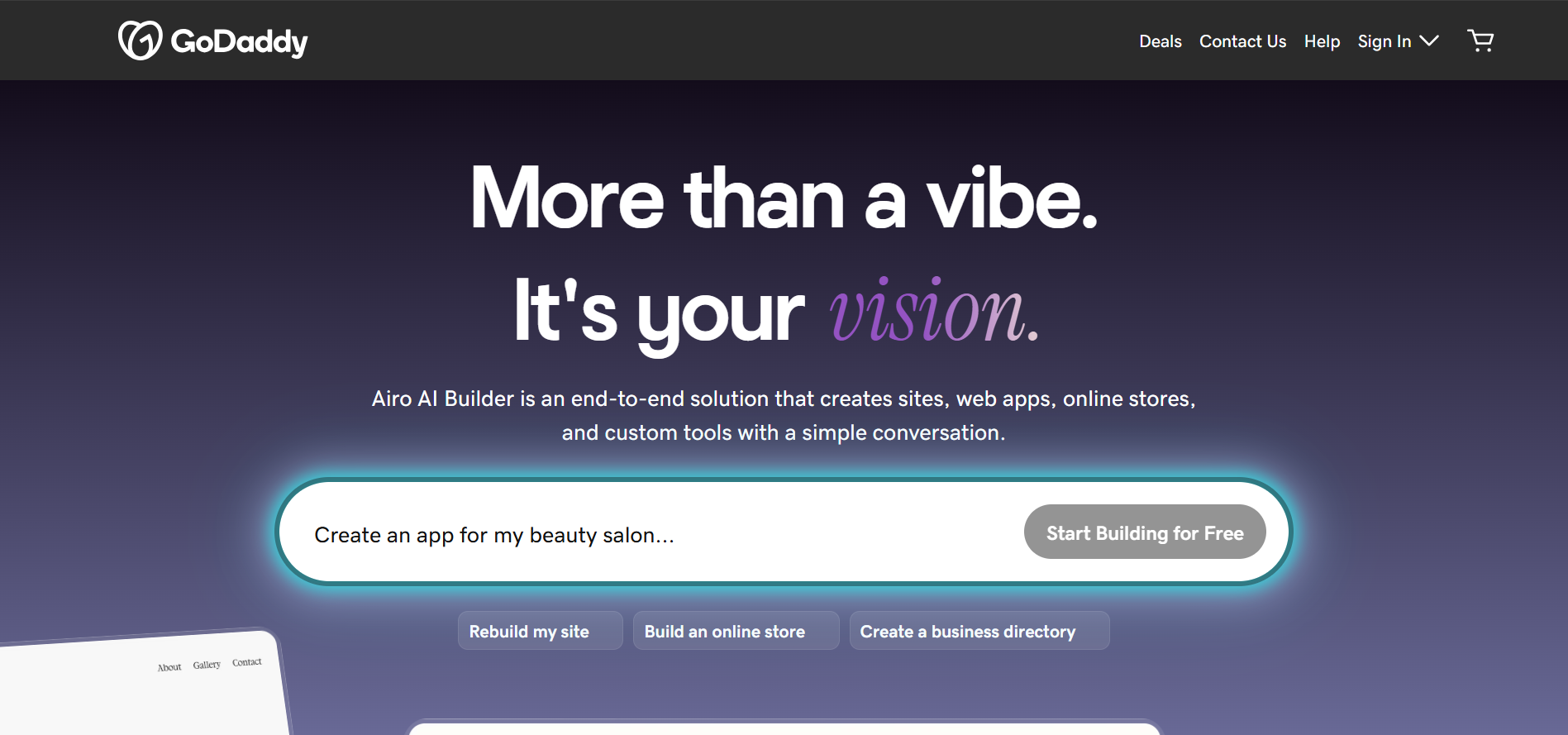
Turns a simple prompt into websites, web apps, online stores, and custom business tools. Describe what you want to build, and Airo generates a working project you can customize and launch without coding.
The best Base44 alternative for you depends on three main factors: your technical ability, the type of project you’re building, and how much control you want over your code in the long run.
Base44 is great for getting a simple app running quickly, but its closed ecosystem and limited export options make it less suitable for teams that plan to scale or customize their applications.
Use this framework to find the best alternative for your situation.
Step 1: Check Your Technical Comfort Level
The first step is understanding how comfortable you are with code. This alone will eliminate several options.
If you’re non-technical and want to stay that way, look for tools that hide complexity behind visual editors and AI prompts:
Hostinger Horizons is the most accessible tool with the simplest entry point for beginners.
GoDaddy Airo also works well for beginners, especially business owners who want to create web applications without having to manage hosting, SSL, or domains separately.
Lovable also works well for beginners who’d like to build applications using AI without dealing with the technical headaches.
On the other hand, if you’re a technical expert and you’re okay with getting your hands on some code, then you should consider:
Emergent; it offers full control, open-stack & testing capabilities.
Bubble is also known for its deep customization and production-grade infrastructure.
If you have some technical or design experience, focus on tools that balance automation with real code output, such as:
Lovable is excellent for quickly building MVPs that developers can later expand.
Step 2: The Tool Should Match Your Project Type
Different tools serve different use cases. Think about what you’re building before choosing a platform.
If your goal is to launch a business presence fast without spending too much:
GoDaddy Airo is the strongest fit. It generates web applications with backend logic included and publishes them directly to GoDaddy’s hosting server.
But if you’re building for production at scale with heavy traffic;
Bubble offers a better advantage with its AWS infrastructure, workflow engine, and 6,000+ plugin marketplace
If your goal is a customer-facing SaaS or public product, go for:
Lovable or Emergent; both create full-stack apps with authentication, payments, and databases.
If you need a simple path to produce applications, then:
You can’t go wrong with Hostinger Horizons.
Step 3: Code Ownership and Flexibility
A platform’s flexibility matters most when your app grows. Some tools let you fully own and export your code; others keep you locked in.
Lovable and Emergent allows you to export and fully own the source code from day one.
GoDaddy Airo allows users to download their code with no restrictions on the plan tier. The codebase belongs to you, and you can decide to use it as you’d prefer.
Bubble does not support code export and ownership. Everything starts and ends on the tool’s server; however, you get extensive control while building on the tool.
Hostinger Horizons does not support direct access to source code. It’s a beginner tool that mainly uses “AI” to build.
Base44 supports code export, but you do not fully own the backend of the code, as it’ll remain on the tool’s proprietary server.
Step 4: Budget and Long-term Value
While almost all platforms listed above offer a sufficient free trial, signing up for a paid plan offers more control, features, and a better experience overall.
If you’re just starting, best to go for plans between ($10 – $25/month). Platforms that meet this criteria are GoDaddy Airo, Hostinger Horizons, Lovable, & Emergent.
If you’re going for more enterprise control or you’re a large team needing better access, you’ll find tools like Bubble to suit your goal.
Step 5: Decide Based on Your Case
Situation
Recommended Tools
Non-technical user or founder trying to build an MVP
Hostinger Horizons or Lovable
User building a production-grade application
Bubble or Emergent
Users building business-like applications
GoDaddy Airo
Users on a tight budget
Hostinger Horizons
Teams needing pixel-perfect design control
Bubble
Users needing clean, structured code they can hand off to any developer to edit or manage
Lovable or Emergent
Users requiring white-label features
Bubble
Users need to build a prototype within seven minutes
Base44
Base44 Alternative: Final Thoughts
Use Base44 only if you need a simple prototype quickly and don’t mind staying within its closed ecosystem. It works well for early testing but not for long-term scalability.
If you care about flexibility, ownership, or customization, consider going beyond Base44. The tools listed above are perfect for various case scenarios.
The best choice isn’t the tool with the most features. It’s the one that matches your skills, your project’s complexity, and your long-term vision.
Base44 Alternatives in 2026: Tried, Tested, & Compared
Is there anything better than Base44?
Yes! Getting a better tool than Base44 depends on your needs and purpose. If you want a platform that’s very easy to navigate and manage, then Hostinger Horizons is a great choice. On the other hand, Bubble is perfect for teams needing pixel-perfect design control, or clean structures with tools like Lovable or Emergent. On the other hand, GoDaddy Airo is designed for business owners needing a speedy yet simple way to get online.
Which is better, Lovable or Base44?
Lovable is the better choice for anyone who values long-term scalability and control. It generates clean, production-grade React and TypeScript code that you fully own and can export to GitHub, unlike Base44’s proprietary structure. While Base44 is faster for complete beginners, Lovable offers more freedom, flexibility, and better developer collaboration.
Is Base44 better than Replit?
Replit Agent generally provides more flexibility and control than Base44. Replit’s AI can plan, build, and debug full-stack apps within a real IDE environment, while Base44 focuses on quick, chat-based generation for simple apps. Replit is better for teams and individuals who may later scale or modify their codebase, whereas Base44 is better for early experimentation.
Is Base44 legit?
Yes. Base44 is a legitimate AI app builder that helps non-technical users create web applications quickly. It’s trusted for rapid prototyping and MVP testing. However, its proprietary database and limited code access can make scaling or migrating projects difficult, which is why many users eventually switch to open, exportable platforms like Lovable.
Can you export code from Base44?
Only partially. Base44 restricts full code access to its $50/month Builder plan, and even then, the exported structure is closely tied to its proprietary ecosystem. If full code ownership is a priority, tools like Lovable and Emergent offer direct GitHub sync and exportability.
Is there a free version of Base44?
Yes! Base44 has a forever-free plan that allows users to build and host fully functional web applications under a capped credit limit (5 per day).
HostAdvice.com provides professional web hosting reviews fully independent of any other entity. Our reviews are unbiased, honest, and apply the same evaluation standards to all those reviewed.While monetary compensation is received from a few of the companies listed on this site, compensation of services and products have no influence on the direction or conclusions of our reviews. Nor does the compensation influence our rankings for certain host companies.This compensation covers account purchasing costs, testing costs and royalties paid to reviewers.